Corporate social responsibility
Sustainability and environmental protection
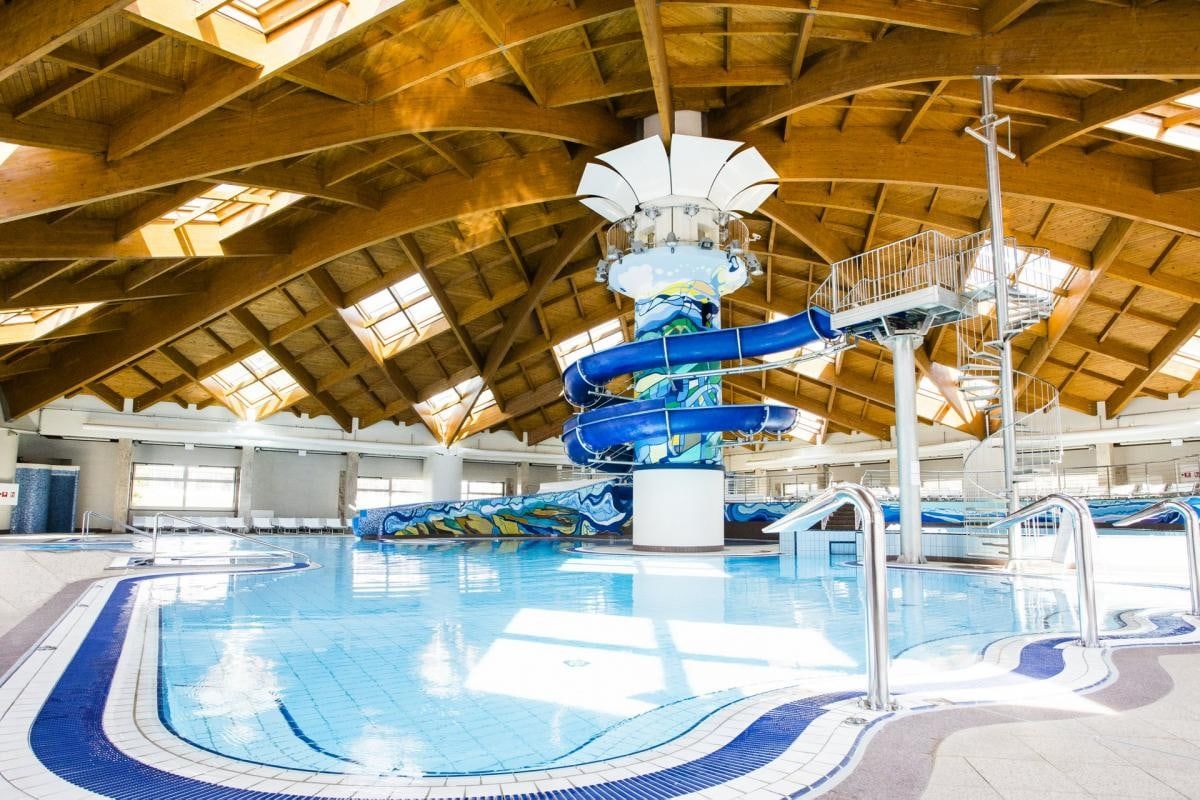
The 18,000 m² water park releases no CO₂ emissions: it draws all the energy for heating its spaces from the heat of the thermal water that fills its pools.
Award in the sustainable tourism category at the 2017 Croatian Tourism Days, from the Croatian National Tourist Board and the Ministry of Tourism.
Energy
How we heat the water park
As the thermal water flows through the water park, it gives up its heat. Of the 18,000 m² building, 9,000 m² is heated, and the temperature in the hall is 28 °C – while the average annual temperature in Krapinske Toplice is 12 °C.
Heat from the thermal water
Cooling one cubic metre of thermal water from 41 to 10 °C releases 36 kWh of heat. Two cubic metres an hour give 72 kW – more than the average 69 kW the park needs (around 600 MWh a year).
The floor slab stores heat
A concrete slab weighing 5,000 tonnes, with a volume of 2,700 m³ and 50 km of underfloor heating pipes, is heated to 33 °C at night, when electricity is cheaper, and cools to 30 °C during the day.
Natural air flow
The heat is stored at the lowest point, so warm air rises naturally from the floor towards the roof, where the air handling units draw it in.
Heat recovery and heat pumps
The air handling units have heat recovery with an efficiency factor of 0.79. When the outside temperature drops below 12 °C, heat pumps of up to 200 kW switch on, in steps of 20 kW.
On the coldest days, down to –20 °C, about three times the average power is needed – 197 kW, which the heat pumps can deliver.
Construction
The heat stays inside
The first task was to build with thermal insulation of very low thermal conductivity. These are the heat transfer coefficients (U) of the parts of the building:
| Part of the building | U (W/m²K) |
|---|---|
| External walls | 0.26 |
| Glass walls (60 mm, low-emissivity glass) | 0.9 |
| Roof (glued laminated timber structure) | 0.2 |
| Roof glazing (triple, low-emissivity) | 1.1 |
Calculating the annual heat demand
Areas: walls 1,600 m², glazing in the walls 800 m², roof 8,200 m², roof glazing 800 m². With an average annual temperature difference of 16 °C, the annual energy needed for heating without ventilation is:
gE = (Uwalls × Awalls + Uglazing × Aglazing + Uroof× Aroof + Uroof glazing × Aroof glazing) × ΔT × 365 × 24 = 595,942,800 Wh ≈ 600 MWh.
Water without added chemicals
Thanks to the composition of the spring water, no chemical treatment other than sodium hypochlorite (NaOCl) is needed to keep the pool water safe. Waste pool water is reused to flush the toilets.
Waste water control
The quantity and quality of the discharged pool water are tested twice a year (pH up to 8, temperature up to 35 °C, active chlorine no more than 0.2 mg/l). These values have never been exceeded.
Waste sorting
We strictly sort paper, plastic, glass, cans, biodegradable waste and used cooking oil, which is collected by a licensed waste collector. Every day we work to reduce the amount of waste as far as we can.
For the honour of the homeland and the benefit of mankind
The water park’s operations have no negative impact on nature, the environment or biodiversity. The absence of pollutant emissions is a healthy foundation for health tourism, for producing healthy food and for spending time in a clean environment.
We can proudly say that, true to Jakob Badl’s motto of 1867, the Aquae Vivae water park serves the honour of the homeland and the benefit of mankind.
See you in the warm water
We are open every day from 9:00 to 21:00. Tickets are sold at the water park reception; no booking is needed.